

Teen Patti Rules and Winning Strategies That Actually Work in 2026
Picture this – it’s Diwali night, the family is gathered around, and someone pulls out a deck of cards. Teen Patti starts, and within minutes, everyone is laughing, bluffing, and trying to win the pot. It’s the one game that needs no introduction in Indian households.
But here’s what separates a regular player from one who consistently walks away ahead: understanding the rules deeply and having real strategies up your sleeve – not just luck.
This article breaks down everything you need: the complete Teen Patti rules, hand rankings, bet types, and practical winning strategies that work whether you’re playing at a family gathering or on a real-money platform online.
What Is Teen Patti – The Basics
Teen Patti literally means “three cards” in Hindi, and that’s exactly what this game is built around. It’s a simplified version of British three-card poker but has evolved into something uniquely Indian over decades.
The game is played with a standard 52-card deck (no jokers) and usually involves 3 to 6 players. Each player gets three cards dealt face down. The goal? Have the best three-card hand – or bluff convincingly enough that everyone else folds.
Before cards are even dealt, every player puts in a fixed minimum bet called the boot amount into the pot. Think of it like the ante. This creates the prize pool everyone is playing for.
One thing that makes Teen Patti different from most card games is the seen vs. unseen mechanic. You can choose to look at your cards (playing “seen”) or keep them face down (playing “blind”). Blind players bet at half the stakes of seen players – and this tension between the two adds a huge psychological element to the game.
Teen Patti Hand Rankings Explained
Knowing the hand rankings is non-negotiable. This is where most beginners stumble – they don’t realize which hand beats which until it’s too late.
Here they are from strongest to weakest:
| Rank | Hand Name | Description | Example |
|---|---|---|---|
| 1 | Trail / Three of a Kind | Three cards of same rank | A-A-A |
| 2 | Pure Sequence / Straight Flush | Three consecutive same-suit cards | A-2-3 of Hearts |
| 3 | Sequence / Straight | Three consecutive cards, different suits | 7-8-9 (mixed suits) |
| 4 | Color / Flush | Three same-suit cards, not in sequence | K-9-4 of Spades |
| 5 | Pair | Two cards of same rank | Q-Q-7 |
| 6 | High Card | None of the above | A-K-J (highest card wins) |
The highest possible hand is three Aces (A-A-A). The lowest hand is 2-3-5 of different suits with no pair.
One hand that surprises new players: A-2-3 is actually the second-best pure sequence possible – Aces can count as both high and low in sequences.
Knowing this table cold is your starting point. If you’re not sure where your hand sits, you’re already losing ground.
How a Round of Teen Patti Actually Works
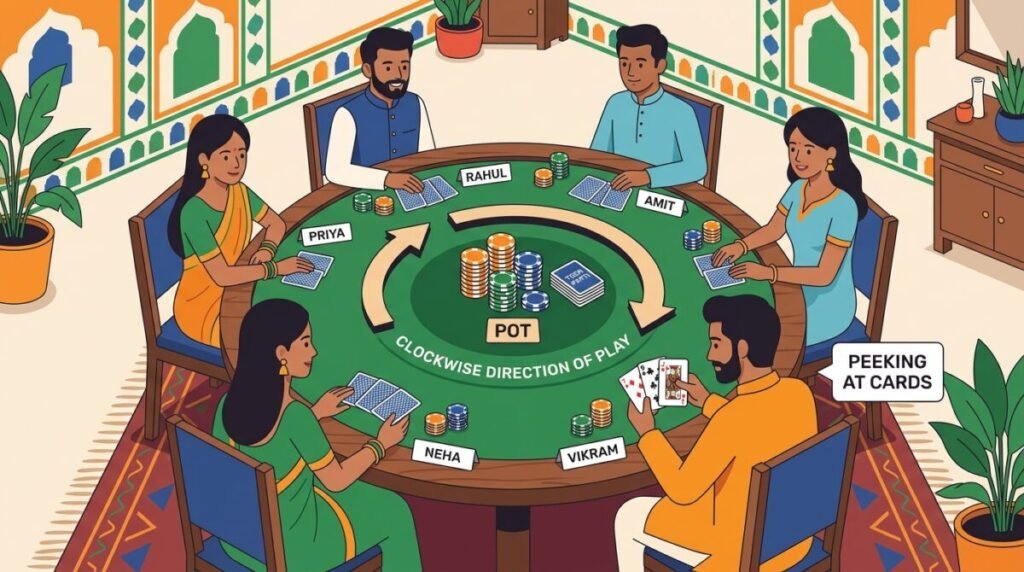
Once the boot amount is in and cards are dealt, the gameplay moves clockwise around the table. Each player, when it’s their turn, has a few choices:
If you’re playing Blind (haven’t seen your cards):
- Bet – place a bet equal to or double the current stake
- Fold – surrender and lose your boot amount
If you’re playing Seen (you’ve looked at your cards):
- Bet – but now your minimum bet is double the blind player’s current stake
- Fold – give up your hand
- Show – if only two players remain, you can pay to see the other player’s cards (costs double the current stake if your opponent is blind, equal if they’re seen)
The round ends when all players except one fold (that last person wins the pot), or when two players face a Show – cards are revealed, and the better hand takes the pot. In case of identical hands, the player who called the Show loses.
One practical tip: keep track of the current stake amount. It escalates quickly, especially if multiple players keep betting without folding. New players often lose track and overbid relative to their hand strength.
Teen Patti Winning Strategies (That Aren’t Just Get Lucky)
This is where things get real. Teen Patti rules only get you so far – strategy is what separates consistent winners from the rest.
Start Blind When You Can
Playing blind keeps your bet costs lower and puts psychological pressure on seen players. A seen player always has to match at least double your stake. Use this early in a round to build tension without committing too many chips – especially useful when you don’t know the table’s playing style yet.
Read the Table, Not Just Your Cards
Pay attention to how others are betting. Someone who keeps raising aggressively as a seen player usually has a strong hand – or they’re bluffing. Someone who checks often as a seen player might be sitting on a weak hand. After a few rounds with the same group, you’ll start reading patterns.
Know When to Fold – Seriously
Let’s be honest: folding feels like losing, but it’s actually a strategic tool. If you’re seen, your hand is weak (say, a low high-card like 5-7-J mixed suit), and two other players are raising aggressively – get out. Chasing a bad hand because you’ve already put money in is one of the most expensive habits in Teen Patti.
The Bluff Window Is Small
Bluffing works in Teen Patti, but only in specific conditions:
- You’re playing blind (cheaper bets, more psychological weight)
- Only 1-2 players remain in the round
- Your opponent seems hesitant (slow to bet, minimal raises)
Bluffing against 3+ active players almost never works. The odds of everyone folding drop dramatically.
Manage Your Stack Actively
Set a mental budget per session – treat it like your UPI wallet. If your session budget is ₹500, know your stopping point. When you’re up by a meaningful amount, consider banking some of it mentally and only continuing to play with a defined remainder. This is basically the same principle as managing your betting budget effectively.
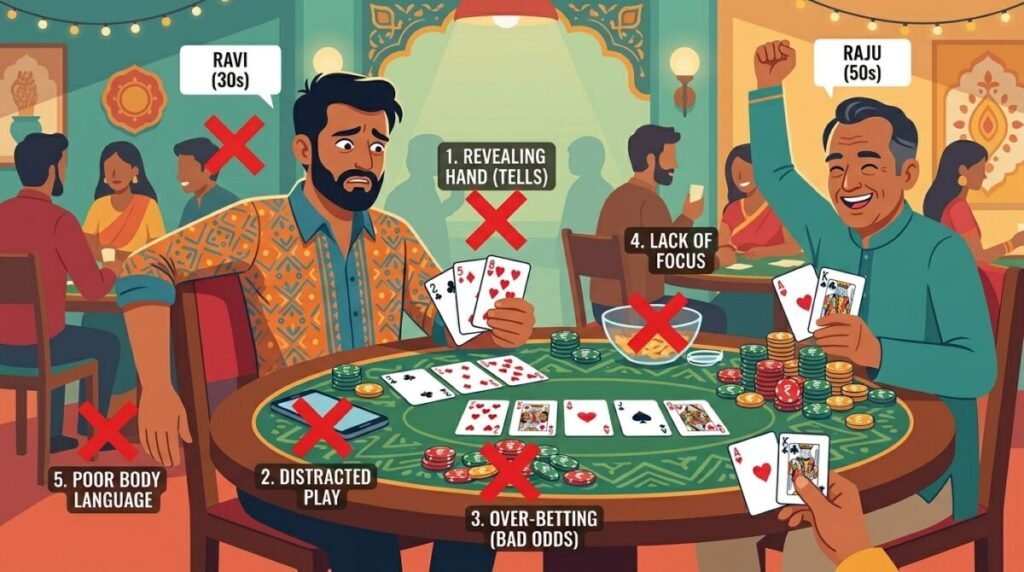
Common Mistakes Beginners Make
Even players who understand Teen Patti rules properly make these mistakes consistently. Avoiding them gives you an immediate edge.
Peeking at cards too early – Once you see your cards, you’re a “seen” player and your minimum bets double. Staying blind longer is a legitimate strategy that new players ignore.
Overvaluing pairs – A low pair (like 2-2-A) is not a strong hand. Many beginners bet heavily on any pair and get burned when someone has a higher pair or better.
Ignoring position – Being one of the last to act each round is an advantage. You’ve seen how others have bet before making your decision. Use that information.
Chasing losses – This is the most damaging mistake. Losing three hands in a row and then going all-in on the fourth to “recover” is how people blow their entire stack. Stick to your pre-decided stakes.
Neglecting sideshow – In many Teen Patti variants, a “sideshow” or “backshow” lets you compare your hand with the previous player’s (if both are seen). If you lose the sideshow, you fold – but this can be a great way to knock out weak opponents early.
If you’re playing online and want to practice without real stakes first, checking out how to bet on Teen Patti online in India is a smart move before putting money on the table.
Playing Teen Patti Online – What You Need to Know
Teen Patti has moved well beyond Diwali nights. Millions of Indians now play on real-money platforms – and the experience is genuinely different from home games.
Speed is faster. Online rounds move quickly. You don’t get the luxury of reading physical body language, so your decisions need to be sharper.
Variants are everywhere. Online platforms offer classic Teen Patti plus variants like Muflis (hand rankings reversed), AK47 (Aces, Kings, 4s, 7s are jokers), and Joker Teen Patti. Stick to classic rules until you’re confident.
Use bonuses wisely. Most platforms offer welcome bonuses and first deposit matches. This is real additional value – treat it as an extended bankroll, not free money to throw around carelessly.
Pick a trustworthy platform. Not all online Teen Patti sites are equal. Look for platforms with clear withdrawal options (like UPI and bank transfer), responsive support, and fair gameplay. You can start by checking out how to choose the best betting app in India to understand what to look for.
If you’re ready to give it a go, registering on Lotus365 takes just a few minutes, and you can also grab the Lotus365 app for smooth gameplay on your phone.
Always keep responsible gambling principles in mind – set time limits, bet what you can afford, and treat it as entertainment first.
FAQs
Three Aces (A-A-A), called a Trail or Set, is the strongest possible hand. After that, A-2-3 of the same suit (Pure Sequence) is second best. If you’re dealt either, playing seen and raising steadily is usually the right move. Just don’t overplay it too early and scare everyone off.
Yes, but the window is narrow. Bluffing works best when you’re playing blind (since your bets are cheaper), there are only one or two active players left, and your opponent seems hesitant. Bluffing against multiple active players rarely pays off – the probability of everyone folding is too low.
A blind player hasn’t looked at their cards and bets at half the minimum stake. A “seen” player has looked at their cards but must bet at least double the blind player’s stake. Staying blind longer keeps your costs lower and adds psychological pressure on seen opponents.
Online skill games including card games like Teen Patti exist in a varied legal landscape across Indian states. Some states permit real-money card games as games of skill, while others have restrictions. You can read a detailed breakdown on the online betting legal guide for India to understand where things stand in your state.
Start by memorizing the hand rankings until they’re automatic. Then practice playing blind more often – it trains patience and forces you to think about bet size rather than hand strength. Playing free online tables before staking real money is genuinely helpful and lets you make mistakes without cost.
The Bottom Line
Teen Patti rules are simple enough to learn in one sitting – but mastering the strategy takes time, patience, and some honest self-assessment of your own playing tendencies. The players who win consistently aren’t just luckier; they manage their bankroll smarter, read the table better, and know when folding is the profitable move.
Start with the fundamentals, practice both the blind and seen strategies, and always play within limits you’re comfortable with. Ready to put it into practice? Create your account on Lotus365 and explore Teen Patti tables today.