
Pitch Report and Its Impact on Cricket Betting 2026
Before every major cricket match, a curator walks out to the center of the ground, kneels down, prods the surface a few times, and makes notes. What he’s assessing becomes the pitch report – and most bettors who see it on Cricbuzz or hear it on the pre-match show treat it like background noise before the toss.
That’s a mistake. A pitch report is probably the most concentrated piece of pre-match information available to a cricket bettor – more actionable than team rankings, more specific than general form, and almost always available hours before the odds fully adjust.
The problem is that pitch reports are written in a very particular language. Expected to have good carry. Likely to take turn from early. Two-paced with variable bounce by day three. If you don’t know what these phrases actually mean in practical terms, the report is useless to you regardless of how carefully you read it.
This article decodes the language of pitch reports – what each term means, what it tells you about match conditions, and how the pitch report and its impact on cricket betting connects directly to the bets you’re considering. No general pitches matter advice – specific terminology, explained clearly.
Where Pitch Reports Come From and When to Find Them
A pitch report is produced by the ground curator – the person responsible for preparing the playing surface. Their assessment is informed by how they’ve prepared the pitch in the days leading up to the match: how much they’ve watered it, whether they’ve rolled it, how much grass they’ve left on, and what the local climate has done to the surface.
This is different from a television presenter’s on-ground report, though both get called pitch reports. The curator’s technical assessment is what the playing XI selection and toss decision are based on. The TV presenter’s version is a visual summary for the audience – useful, but less precise.
When to find them:
- Cricbuzz and ESPNcricinfo both post curator or ground reports in the match preview section, usually the evening before or on match morning
- Official BCCI press conferences before home matches often include curator input
- Broadcast teams typically deliver their version 30-45 minutes before the toss
Here’s the timing edge: pitch reports often appear 12-24 hours before a match, and the betting odds may not fully adjust to the implications immediately – especially for niche markets like total wickets or method of dismissal. Reading the report early and understanding it properly gives you a window before the market fully corrects.
The same discipline applies before any major betting decision. Checking the pitch report is one item on a pre-match checklist – pairing it with squad news and weather data gives you the full picture. For how to structure that overall approach, top cricket betting strategies for matches covers the wider pre-match preparation framework.
Decoding the Core Terminology – Pace, Bounce, and Carry
These three words appear in almost every pitch report. Most people have a general sense of what they mean, but the distinctions matter for betting.
Pace
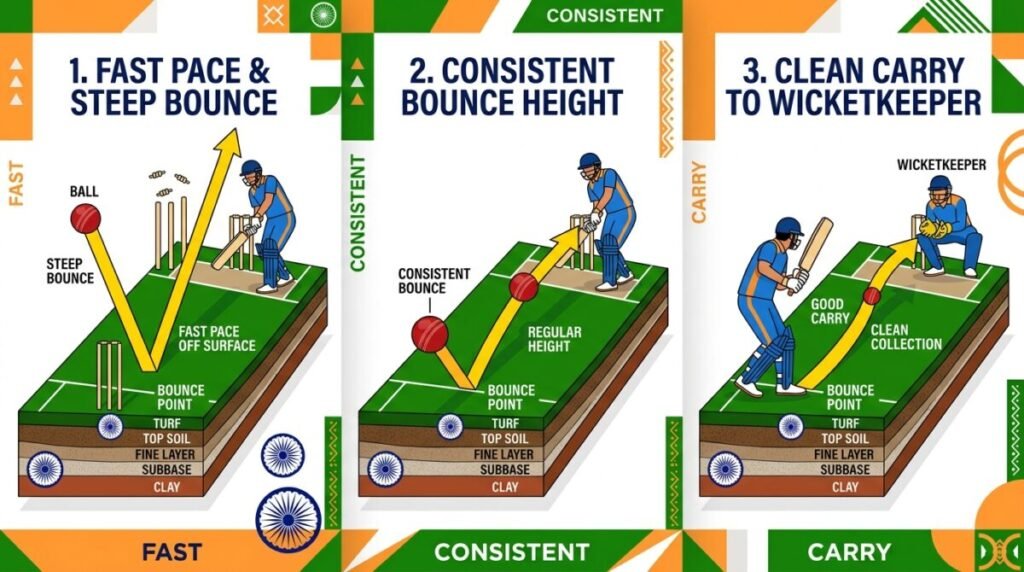
Pace in the pitch means the surface responds to the ball’s momentum – when a fast bowler bowls, the ball comes off the surface quickly, reaching the batter with pace retained. Batters who play through the line of the ball (as opposed to relying on soft hands or late adjustments) tend to thrive here.
A slow pitch does the opposite – it grips and slows the ball, meaning batters have to generate their own timing rather than using the bowler’s pace. Strokemaking becomes harder. Run rates tend to be lower in the first half of an innings on slow pitches.
Betting implication: Slow pitch expected in a T20 context typically suppresses powerplay scoring. First-innings total runs markets are a direct application here.
Bounce
Good bounce means the ball rises consistently from the pitch – predictable, true, and even. Batters can play with confidence knowing the ball will come to them at a consistent height.
Uneven bounce or variable bounce is the dangerous version – where the ball rises sharply from one delivery and stays low on the next, from the same length. This makes batting genuinely difficult and increases wicket probability. You’ll see this language in pitch reports for dry, crumbling surfaces, particularly in the later stages of Test matches.
Carry
Good carry to the keeper means the ball travels through to the wicketkeeper without losing pace or shape – important for edges being caught behind the wicket. On pitches with good carry, catches behind (caught keeper or slips) become more likely. On low pitches with poor carry, those same edges fall short.
Betting implication: Good carry expected increases the probability of caught-behind dismissals – a specific insight for method of dismissal markets.
Grass Cover, Moisture, and What They Mean for Bowlers
The visual appearance of a pitch – specifically how much grass is on it – is one of the most immediately readable signals in a pre-match pitch report.
Grass Cover
Good grass cover or green top: The pitch hasn’t been heavily rolled and retains visible grass. This almost always means early assistance for pace bowlers – the ball grips the surface irregularly, causing lateral movement (seam movement rather than swing through the air). Teams winning the toss in these conditions almost universally choose to bowl first.
Dried out surface with minimal grass: The pitch has been prepared for batters and spinners. Fast bowlers will need to find movement through the air (swing) rather than off the surface.
Brown, dry surface: The pitch has been prepared in dry conditions and will almost certainly deteriorate – producing turn and variable bounce by the middle overs of an ODI or the third day of a Test.
Moisture Content
Moisture in a pitch is a short-term advantage for pace bowlers – but it dries out rapidly under sun and play. A moist surface in the morning session of a Test can become completely different by the afternoon. This is why toss decisions in Test cricket are so heavily debated.
Morning moisture expected to dry by afternoon: The pitch report is telling you there will be two different pitch phases in the same day. Bowling first to exploit the moisture, then batting as the surface dries, is the strategic preference – and it’s exactly the logic that drives toss decisions.
The Two-Paced Pitch
This phrase deserves its own mention because it appears often and confuses many readers. Two-paced means the pitch is inconsistent – sometimes the ball comes quickly and sometimes it grips and slows, even from similar deliveries. It’s essentially unpredictable bounce combined with unpredictable pace. Spinners and cutters (medium pacers who use seam and finger position to change pace) benefit significantly on two-paced surfaces. Aggressive batters who play through the line struggle.
Reading a Spin-Friendly Pitch Report Correctly
Spin-related pitch report language is particularly important for Indian conditions, where pitches at venues like Chepauk, Nagpur, and Indore regularly produce significant turn – sometimes from the very first over.
Key Spin Terminology
Expected to take turn from early: Spinners will get grip and lateral movement from ball one. This is a significant advantage for teams with quality spin bowling. It also means batters who struggle against spin will be exposed from the opening overs.
Variable turn: The ball won’t spin consistently – sometimes biting sharply, sometimes skidding through. This is actually harder to bat against than consistently heavy turn, because you can’t set a fixed game plan. Variable turn increases the probability of unexpected wickets.
Deteriorating pitch / will crumble by day 3: In Test cricket, this is the phrase that defines how matches play out. A pitch that begins playable and crumbles into the third and fourth days massively advantages the team batting first. Winning the toss on a deteriorating pitch report is almost always followed by a decision to bat.
Dust on the surface: Dry, granular surface that has lost its binding. Spinners love this – the ball grips and turns sharply. Expect lower totals, more LBW dismissals to spinners, and longer odds on batting-heavy totals.
A Practical Spin Pitch Example
During the 2023 Border-Gavaskar Trophy in India, pitches in Nagpur and Delhi produced significant turn from day one. The pitch reports ahead of both Tests clearly described dusty, dry surfaces. Teams batting second in both Test matches faced enormous fourth-innings targets on deteriorating surfaces. Bettors who read those pitch reports correctly and backed the team batting first to win had a genuine information edge over those who based their bets on head-to-head records or general form alone.
How Pitch Reports Translate Into Specific Betting Decisions
Understanding pitch report language is only useful if it changes how you bet. Here’s a direct translation from report language to market implications:
| Pitch Report Phrase | What It Means | Markets Most Affected |
|---|---|---|
| Good pace and carry | Ball comes quickly, edges carry to keeper | Total runs (higher), caught behind dismissals |
| Slow and low | Ball grips, stays down | Total runs (lower), LBW rates higher |
| Green top, good grass cover | Seam movement for pacers | Top wicket-taker (pace bowler), toss decision critical |
| Turn from early | Spinners dominant from ball one | Top wicket-taker (spinner), first innings total lower |
| Variable bounce | Unpredictable, difficult for batters | Total wickets (higher), match winner more uncertain |
| Two-paced surface | Inconsistent pace off pitch | Medium-low total runs, spinners and cutters favoured |
| Dry, dusty surface | Heavy turn, deteriorating | Team batting first to win (Test), lower totals |
| Moist, morning moisture | Early seam movement, dries later | Toss is critical, bowling first preferred |
The most important column here is markets most affected – because once you’ve decoded the pitch report language, the question is immediately which bet does this change? Not every pitch report changes every market equally. A green top matters enormously for top wicket-taker and method of dismissal. A slow pitch matters most for total runs and powerplay performance. A deteriorating Test pitch changes match winner market odds significantly.
Applying this table to any pitch report you read gives you a structured process: decode the language first, then identify which markets your new information should affect.
For building the wider habits around bankroll management that let you act on this kind of research consistently – rather than just occasionally – how to manage your betting budget in India is worth keeping alongside your pitch research routine.
Venue-by-Venue Cheat Sheet – Major Indian Grounds
Knowing general terminology is one thing. Having a quick mental model of what to expect from each major Indian venue gives you a head start before you even read the specific match report.
Wankhede Stadium, Mumbai: Generally good pace and carry, sometimes with swing in overcast conditions. Shorter boundaries mean higher scoring games. Pace bowlers tend to do well early; conditions are batter-friendly by the middle overs on most IPL nights.
M.A. Chidambaram Stadium, Chennai (Chepauk): One of India’s most spin-friendly venues. The surface dries quickly and turn is almost always available for quality spinners. Dew in evening matches can somewhat counteract this in the second innings. Spinners historically dominate here.
M. Chinnaswamy Stadium, Bengaluru: A high-scoring ground with short boundaries and a flat, true surface. Batters thrive, run rates are consistently high, and totals are regularly above par. Slower bowlers who can exploit the short straight boundary have had success.
Eden Gardens, Kolkata: Good pace early, and the pitch can offer seam movement on the first morning of Tests. In IPL conditions, it becomes more batting-friendly as the surface is prepared for T20 play. Weather is a real factor here in April-May (pre-monsoon).
Sawai Mansingh Stadium, Jaipur: One of India’s drier venues. Pitches tend to be slow and favour spin by the second half of matches. Totals are often modest by IPL standards, and spinners who bowl accurately tend to do well.
Himachal Pradesh Cricket Association Stadium, Dharamsala: The altitude means the ball travels further through the thin air – good for batters and genuinely tough for bowlers to control. Outswing can be more pronounced. Weather changes rapidly here and is worth monitoring closely.
Having this mental map means the pitch report you read before an IPL match at Chepauk is already understood in context – you’re confirming what you broadly expect rather than starting from zero.
If you’re ready to apply this kind of preparation to real cricket bets, Lotus365 covers all major Indian venues and tournaments with live odds that update as pitch and weather information comes in. Register your account before the next IPL season begins, or download the Lotus365 app to follow pitch reports and markets from anywhere.
Always keep responsible gambling habits front of mind – knowing how to read a pitch report improves your decision-making, but it doesn’t eliminate the inherent unpredictability of cricket.
FAQs
The Report Is Telling You the Match Before It Starts
The pitch report and its impact on cricket betting is ultimately about having more information than the next bettor – but only if you can translate what the report is actually saying. Pace, carry, bounce, grass cover, moisture, turn – these aren’t vague cricket terms once you know what each one means for bowlers, batters, and the markets you’re considering.
Read the pitch report the night before. Decode the language using what this article covers. Then apply it specifically to the markets where pitch conditions have the most impact: total runs, top wicket-taker, method of dismissal, and toss-related live bets. Ready to start applying this? Register on Lotus365 and explore cricket markets with real match conditions built into your preparation – or download the Lotus365 app to follow pitch and weather updates on match day wherever you are.