
Top 5 Cricket Betting Mistakes Indian Bettors Make
A friend who bets seriously on IPL once told me something that stuck: My first season, I knew cricket better than most people I knew. I still lost money almost every week. He wasn’t betting badly because he didn’t understand the game. He was betting badly because he understood cricket but didn’t understand betting.
That gap – between cricket knowledge and betting discipline – is exactly where most Indian bettors lose money. And the frustrating part is that the top cricket betting mistakes Indian bettors make aren’t random or unpredictable. They’re the same errors, repeated by different people, season after season.
This article covers five of the most damaging mistakes specifically – not vague advice like bet responsibly, but the actual patterns that drain bankrolls. Each one comes with a real-world example and a concrete fix. By the time you finish reading, you’ll recognize these mistakes not just in general, but in your own past bets. That’s when things start to change.
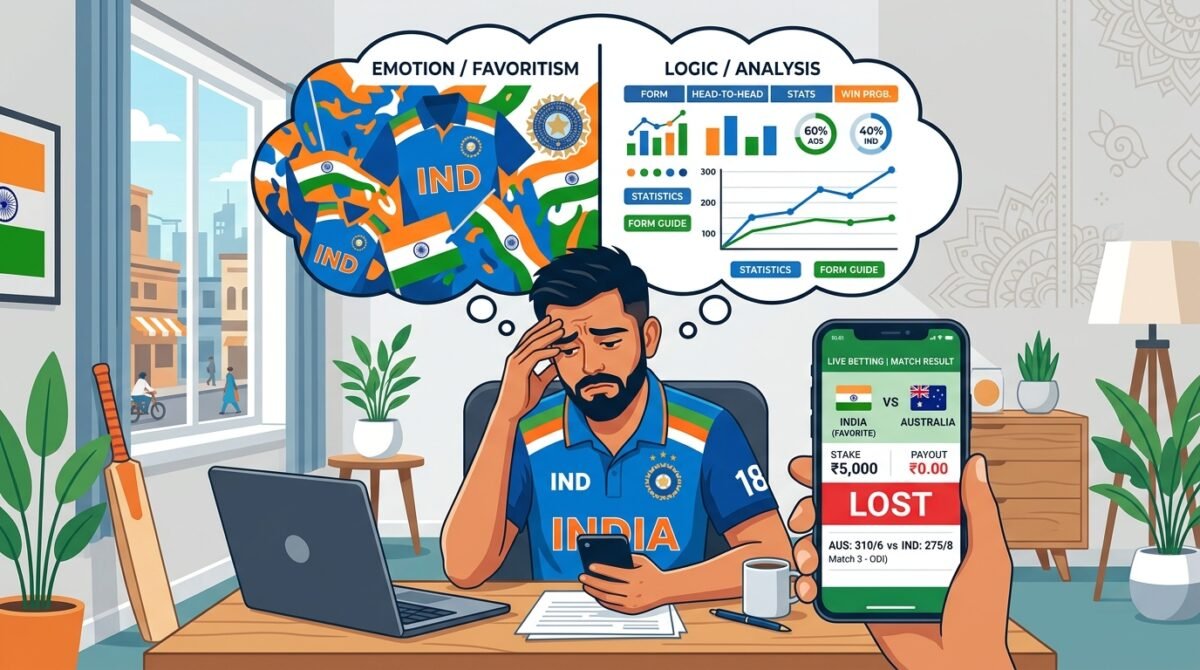
This is the most common of the top cricket betting mistakes Indian bettors make – and the hardest to admit, because it doesn’t feel like a mistake when you’re doing it.
You’ve watched India play for twenty years. You know Rohit Sharma’s technique, you’ve seen Bumrah perform under pressure, and you genuinely believe India will win the semifinal. So you bet on India – not because the odds offer value, but because you can’t imagine the alternative.
That’s not analysis. That’s fandom with a financial stake attached.
Here’s the thing: emotional betting doesn’t just make you back the wrong team occasionally. It affects how much you bet. When you’re emotionally invested, you bet more than you should – and when India lose, you chase the loss because it feels personal.
The Fix
Treat your team and your bet as completely separate decisions. Ask yourself: If I had no favourite team in this match, what would the evidence tell me? Form, pitch conditions, head-to-head record, squad fitness, and toss result should drive the decision – not loyalty.
A practical habit: write down your three main reasons for a bet before placing it. If any of those reasons are emotional rather than factual (they’ve been playing well recently is factual; they always perform in big matches is emotional), reconsider the stake size at minimum.
During the 2023 World Cup, India were heavy favourites in almost every match – and the odds reflected it. Bettors who backed India blindly throughout found very little value in short odds and one devastating final to absorb. Bettors who approached each match objectively found value in specific markets even when India were involved.
Mistake 2: Ignoring the Odds and Chasing Big Returns
The second major mistake is almost the opposite problem from Mistake 1 – instead of betting emotionally on favourites, some bettors chase the big odds regardless of whether they make sense.
Odds of 7.00 on a team look exciting. That’s seven times your money. But if the implied probability is 14.3% and there’s genuinely no reason to think that team has more than a 14% chance – the odds aren’t a bargain. They’re just big numbers.
This is where understanding implied probability becomes critical. Every decimal odd converts to a probability: divide 1 by the odds. Odds of 7.00 = 1 ÷ 7 = 14.3% chance. Odds of 1.50 = 66.7% chance.
The Real Cost of Chasing Big Odds
Suppose you back a 7.00 shot once a week for 10 weeks, betting ₹500 each time. Total outlay: ₹5,000. If that team wins once (which 14% probability suggests they might, across 10 bets), you get ₹3,500 back. You’re still down ₹1,500.
Now suppose you’d backed sensible value bets at 2.00 odds with genuine 55% win probability each time. Same ₹500 per week, same 10 weeks. You’d expect roughly 5-6 wins, returning ₹5,000-6,000 on a ₹5,000 outlay – approximately break-even or slightly profitable.
| Bet Type | Odds | Implied Probability | 10-Week Result (₹500/bet) |
|---|---|---|---|
| Long-shot chasing | 7.00 | 14.3% | ~1 win = ₹3,500 return on ₹5,000 spent |
| Value betting (moderate odds) | 2.00 | 50% | ~5 wins = ₹5,000 return on ₹5,000 spent |
| Favourite-only betting | 1.30 | 76.9% | ~8 wins = ₹5,200 return on ₹5,000 spent |
The long-shot approach consistently underperforms over time. The fix is to focus on whether your own estimate of probability is higher than what the odds imply – not whether the potential return looks impressive.

Mistake 3: No Bankroll Structure – Betting Random Amounts Each Time
Ask most bettors how much they bet per match and you’ll get a shrug. Depends how confident I am. That’s the problem right there.
Betting random amounts based on confidence level sounds logical but creates two serious problems. First, your confidence is not a reliable signal – overconfident bets after a winning streak are one of the most common bankroll killers in cricket betting. Second, it means a single bad loss on a high confidence bet can wipe out gains from ten smaller wins.
What Structured Bankroll Management Looks Like
Professionals use a unit system. Your total betting budget for a season – say ₹10,000 – is broken into units. A standard bet is 1-2 units. A high-confidence bet is 3 units maximum. You never bet more than 5% of your total bankroll on a single event, no matter how certain you feel.
Here’s a concrete example: You start IPL season with ₹10,000. Your standard bet is ₹200 (2%). A match you feel very confident about gets ₹400 (4%). You never go above ₹500 on a single match (5%).
This approach means a bad run of 5 consecutive losses costs you ₹1,000-₹2,000 at most – painful, but survivable. Without structure, that same losing run on high confidence bets of ₹1,500 each costs you ₹7,500 and effectively ends your season.
Think of it like managing a SIP investment. You don’t put your entire portfolio in one stock because you feel good about it. You spread, you set limits, and you protect the principal.
How to manage your betting budget in India covers the unit system and other bankroll frameworks in full – worth reading before IPL season begins each year.
Mistake 4: Overloading on Accumulators and Multi-Bet Slips
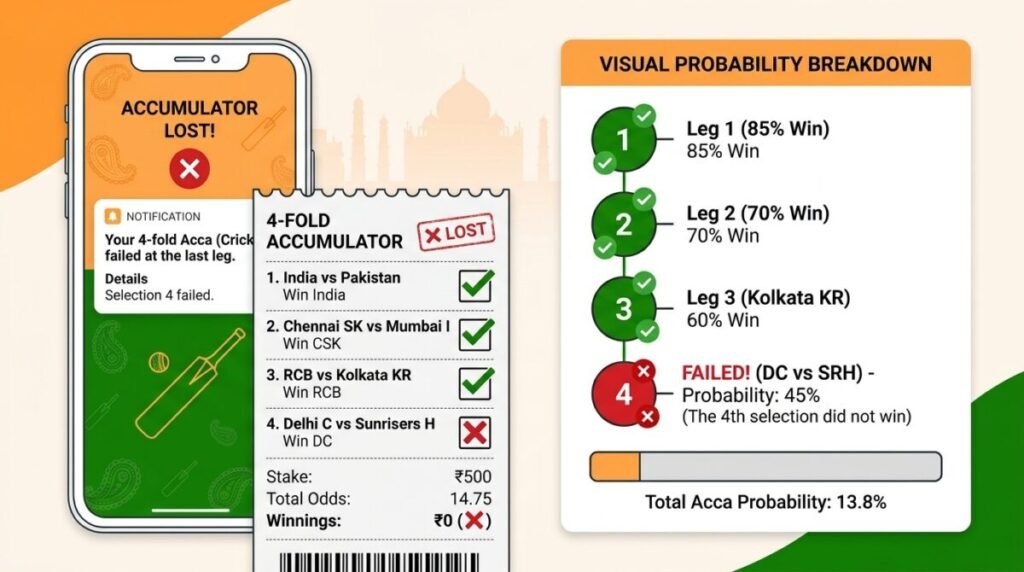
Multi-bets – where you combine several selections into one slip for a multiplied payout – are incredibly popular among Indian bettors during IPL. You back 4 match winners in one slip, the odds multiply, and suddenly you’re looking at 12.00 returns on a ₹100 bet.
The problem is mathematics, not excitement.
For an accumulator to pay out, every single selection must win. If you have four 60% probability bets on one slip, the combined probability of all four winning is 0.60 × 0.60 × 0.60 × 0.60 = 12.96%. You have roughly a 1-in-8 chance of winning that slip, even when each individual selection is more likely to win than not.
Why Platforms Love Accumulators
Here’s why they’re aggressively promoted: the bookmaker’s margin compounds across every leg of the accumulator. On a single bet, the margin might be 4-5%. On a four-leg accumulator, that margin compounds across each selection. The actual expected return for the bettor gets worse with every leg added.
The Better Approach
This doesn’t mean you should never do multi-bets. It means treating them as occasional entertainment with a small, ring-fenced budget – not as your core betting strategy.
Limit yourself to two or three legs maximum if you enjoy the format. Never put more than 5-10% of your session budget on an accumulator. And calculate the combined probability before you get excited about the payout.
A four-team IPL accumulator during a Tuesday-Wednesday double-header looks fun. It nearly never pays out. Single match bets, placed thoughtfully on matches you’ve actually researched, consistently outperform accumulator strategies over any meaningful sample size.
For developing the wider habits that protect your betting – including how to set deposit limits and session caps – responsible gambling tips for Indian bettors covers the practical side.
Mistake 5: Skipping Research on Pitch, Weather, and Team News
The fifth of the top cricket betting mistakes Indian bettors make is the most avoidable – and yet it’s extremely common, especially during high-frequency tournament periods like IPL when there’s a match nearly every day.
When matches come thick and fast, bettors start placing bets based on general impression rather than match-specific research. CSK are in good form is not research. It’s a vibe. And vibes don’t account for the fact that this particular match is at a spin-friendly Chepauk pitch, CSK’s first-choice spinner is rested, and there’s a 60% chance of light rain affecting the second innings.
The Three Factors Most Bettors Skip
Pitch report: Every major cricket venue in India plays differently. Wankhede in Mumbai is fast and true – pace bowlers and batters thrive. Chepauk in Chennai gives assistance to spinners from day one. Chinnaswamy in Bengaluru is a high-scoring ground. These aren’t optional pieces of information – they directly determine which bet types offer value.
Team news and playing XI: A squad announcement 45 minutes before a match can completely change the pre-match landscape. A key batter rested, an overseas pacer replaced by a local spinner, or a keeper-batter promoted up the order – these matter enormously for top batsman markets, total runs markets, and match winner odds.
Weather and dew: Already covered in a dedicated article, but worth repeating here: day-night matches in India are heavily affected by dew in the second innings, which consistently benefits the chasing team. If you’re betting on match winner without accounting for dew, you’re missing a significant variable.
Fifteen minutes of pre-match research – pitch report, playing XI, weather forecast – is the most straightforward edge available to any bettor. Most people skip it because they’re excited to place a bet before the toss. Don’t be that person.
For building an entire pre-match research process, top cricket betting strategies for matches goes deeper into how professionals approach preparation.
The Bigger Picture – Patterns Behind the Mistakes
Step back and look at the five mistakes together and a pattern emerges: they’re all variations of the same core problem – reacting instead of deciding.
Emotional betting is reacting to team loyalty. Chasing big odds is reacting to the appeal of a large number. Random bet sizing is reacting to confidence in the moment. Accumulator overload is reacting to the thrill of a big payout. Skipping research is reacting to the urgency of the match starting.
Every one of these can be corrected with a simple pre-bet checklist:
- Have I calculated my potential return in rupees?
- Have I checked the implied probability and compared it to my own estimate?
- Is my stake within my pre-set unit limit for today?
- Am I betting on a single, researched selection rather than stacking legs?
- Have I checked pitch, weather, and playing XI in the last hour?
If you can answer yes to all five before every bet, you’re already operating at a level above most casual bettors in India.
If you’re just starting out and want a platform that gives you clear odds, fast live markets, and a clean interface to practice these habits, Lotus365 is a reliable place to begin. Create your account to get started, or grab the Lotus365 app so you have everything you need on your phone when IPL season runs.
FAQs
Stop Repeating the Same Costly Errors
The top cricket betting mistakes Indian bettors make aren’t complicated – they’re just consistent. Emotion over evidence, chasing inflated odds, random stake sizes, accumulator overload, and skipping match-day research are the five patterns that drain most beginner and intermediate bettors across every IPL season.
Fixing even two or three of these changes your results more than any tipster or guaranteed strategy ever will. Discipline and preparation are the actual edge. If you’re ready to apply that thinking with real cricket bets, register on Lotus365 and start your next IPL season with a cleaner approach – or download the Lotus365 app and have everything you need in your pocket.