How to Bet on India vs Pakistan Matches – A Smart Bettor’s Guide for 2026
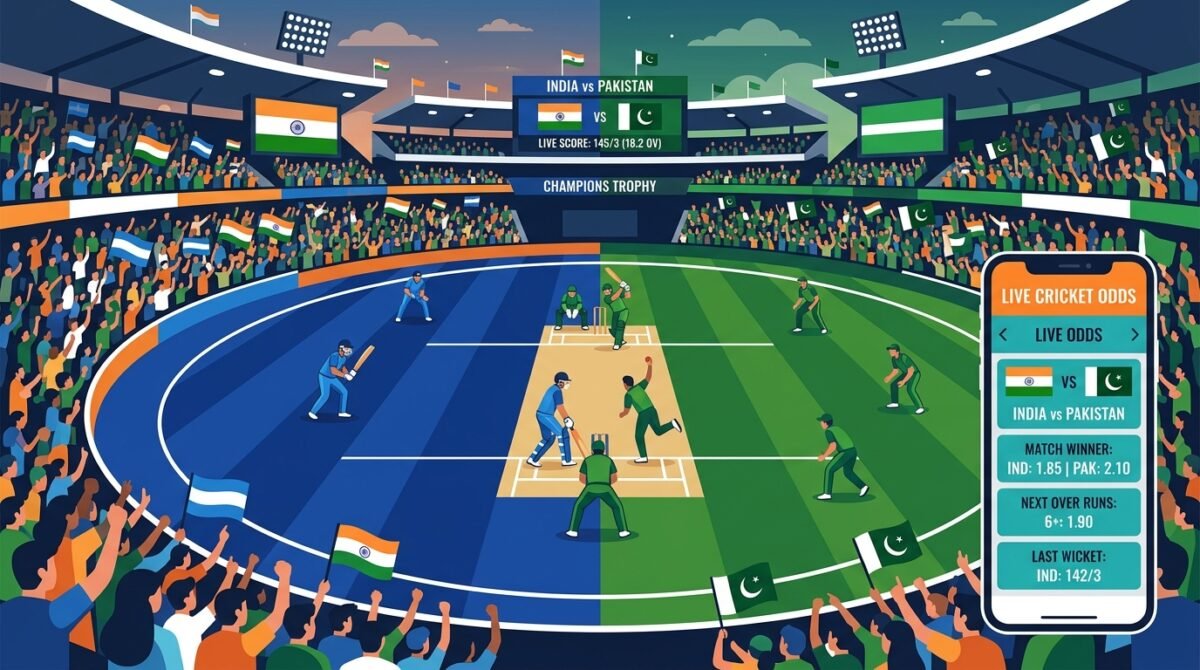
No other cricket fixture does what India vs Pakistan does to the country. The week before the match, everyone has an opinion. WhatsApp groups are firing. Offices are debating team combinations. And on the betting platforms, the volume of wagers placed on a single India-Pakistan T20 World Cup match routinely dwarfs what you’d see across an entire week of domestic fixtures.
That kind of emotional intensity is exactly what makes this fixture a trap for bettors who haven’t thought it through.
Understanding how to bet on India vs Pakistan matches requires something most people don’t apply to this particular game: objectivity. The odds move differently, the markets behave differently, and the psychological pressure on casual bettors is unlike any other cricket match on the calendar.
This guide covers the specific betting dynamics of India-Pakistan matches – which markets offer the most value, how odds are set and shift, what head-to-head data actually tells you, and how to approach the fixture as a bettor rather than a fan. Whether it’s a T20 World Cup group stage game or an Asia Cup encounter, the principles hold.
Why India vs Pakistan Betting Is Different From Every Other Match
The sheer volume of money that flows into India-Pakistan matches distorts the market in ways that don’t happen in other fixtures. Bookmakers know that the vast majority of Indian bettors will back India – not because of careful analysis, but because of national loyalty. That predictable bias gets priced in.
What this means practically: India’s odds on an India-Pakistan match are often slightly shorter (less generous) than they would be if the same two teams played under a different flag or in a different context. The bookmaker is adjusting for the flood of patriotic money coming in, making the India side slightly less profitable to back than raw probability would justify.
Pakistan’s odds, conversely, are often slightly longer – offering more value than their actual win probability suggests – because proportionally fewer bettors back them, at least among the Indian audience.
This isn’t always dramatic. You’re not going to see India priced at 1.20 when they should be 1.45. But a 10-15% difference in implied probability is meaningful when you’re placing a considered bet rather than a sentimental one.
Now here’s where it gets interesting: this bias creates a structural opportunity for bettors who approach the fixture analytically. Backing Pakistan in markets where they genuinely have a strong case – specific venue, favourable pitch conditions, form advantage – can offer better value than the same bet on a neutral team in equivalent circumstances.
How to Bet on India vs Pakistan Matches – Key Markets Explained
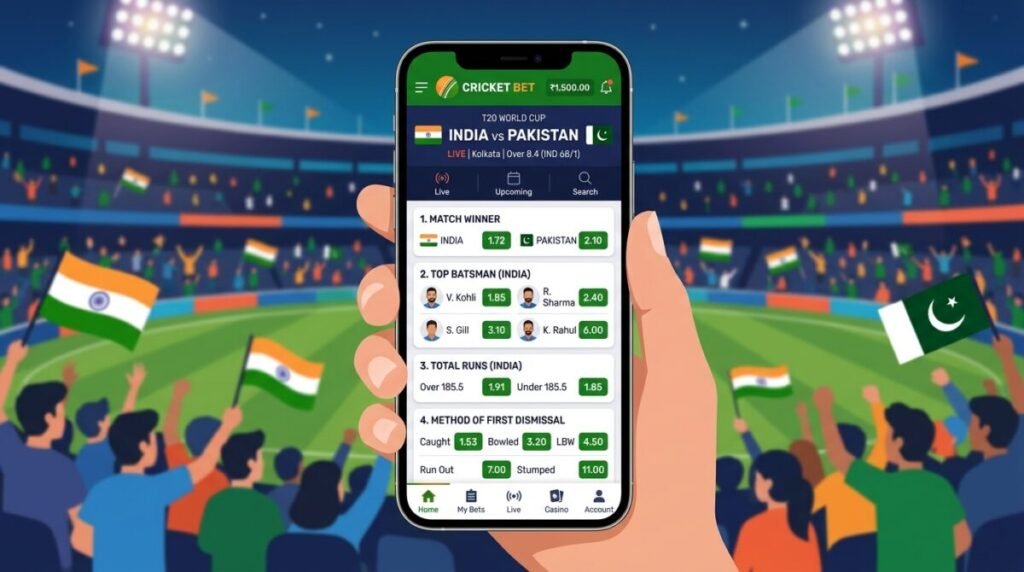
The match winner market gets all the attention, but it’s rarely where the sharpest value sits in an India-Pakistan fixture. The emotion baked into the winner market makes it efficient very quickly – by match day, it’s hard to find genuine mispricing there.
These markets tend to offer better opportunities:
Top Batsman Markets
Individual performance markets are less affected by national sentiment because they require specific cricket knowledge. Who is in form? Which player has a strong record at this venue? Who tends to perform in pressure situations vs. who wilts?
For India, players like Virat Kohli have remarkable India-Pakistan records in ICC tournaments – backing Kohli for top scorer when he’s in good touch has historically offered solid value. On Pakistan’s side, Babar Azam and Mohammad Rizwan have been consistently productive openers. These records matter in player markets.
Total Runs Markets
Over/Under runs markets – will the first innings exceed 165 runs? – are heavily influenced by venue and pitch. India-Pakistan ICC matches are often played on subcontinental surfaces or neutral venues in the Gulf, where conditions tend to be flat and high-scoring. Knowing the venue and its recent scoring history is critical here.
Method of First Dismissal and Player Performance Props
On turning or low-bounce pitches, LBW and bowled rates go up. On true, flat surfaces, caught in the deep becomes the dominant dismissal type. These niche markets require actual match preparation to bet intelligently – and because fewer bettors engage with them, pricing can occasionally be generous.
For a broader look at which markets suit different levels of cricket knowledge, top cricket betting strategies for matches covers the full range.
Reading the Odds: What the India-Pakistan Price Says About Probability
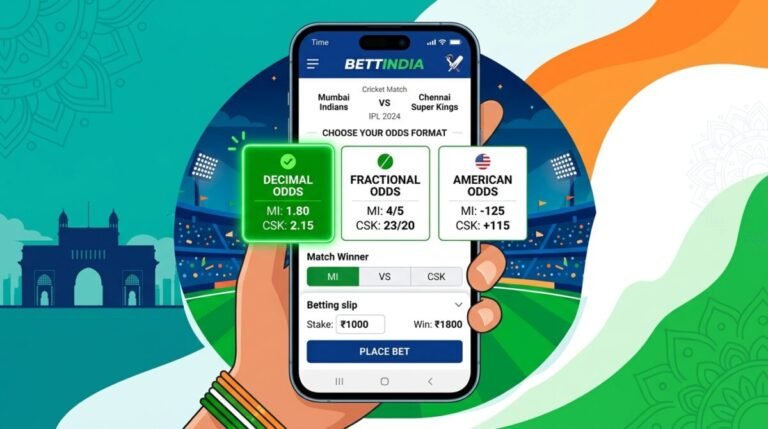
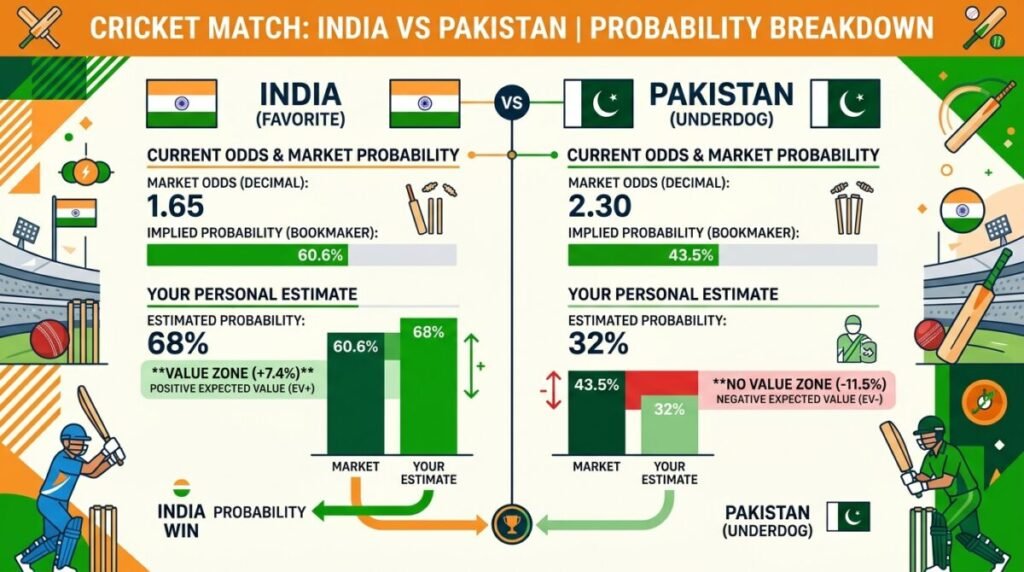
Every decimal odd is a probability statement. Knowing how to convert it is essential before you bet on any India-Pakistan fixture.
The formula: Implied Probability = 1 ÷ Decimal Odds × 100
So if India are priced at 1.65 and Pakistan at 2.35 for a T20 World Cup fixture:
| Team | Odds | Implied Probability | Bookmaker Margin |
|---|---|---|---|
| India | 1.65 | 60.6% | Combined margin: ~3% |
| Pakistan | 2.35 | 42.6% | – |
| Total | – | 103.2% | 3.2% bookmaker edge |
India are the favourites at roughly 60% probability. Pakistan at 42.6%.
Now your job as a bettor is to form your own honest estimate. If you look at current form, venue conditions, squad fitness, and head-to-head in T20s and genuinely believe Pakistan have a 50% chance of winning – the odds at 2.35 represent real value. You’re getting 42.6% odds on a team you think has 50% probability.
If you think India’s chances are actually 65%+ based on the same research, then India at 1.65 is fair but not exceptional value.
The key discipline: don’t let the result you want influence the probability you assign. These are two completely separate mental exercises.
One more thing – watch how odds move between announcement and toss. A significant drift toward Pakistan (odds rising on India, shortening on Pakistan) often signals squad news or a pitch report that favours Pakistan. Sharp money moving the market is a signal worth reading.
Head-to-Head Record and What It Actually Tells a Bettor
India have an exceptional record against Pakistan in ICC tournament cricket. As of recent tournaments, India have won the vast majority of their ICC knockout and group stage encounters. This is a real, documented statistical advantage – and it’s already priced into the odds.
Here’s the trap: most Indian bettors treat the head-to-head record as a reason to back India confidently. But if that record is already reflected in the odds – meaning India’s price is shorter because bookmakers know this history – then backing India based purely on the record doesn’t give you any edge. You’re just agreeing with the market.
What Head-to-Head Data Is Actually Useful For
Head-to-head data becomes valuable when you break it down by specific conditions:
- Format: India’s ICC T20 record vs. Pakistan is different from their ODI record vs. Pakistan. Know which format you’re betting on and use the relevant subset.
- Venue: Results at neutral venues in UAE and Sri Lanka may differ from results in subcontinental conditions. Some players perform differently away from home crowds.
- Phase of tournament: Group stage encounters have different psychological dynamics from knockout matches. Pressure management varies.
- Recent form over historical record: A team on a strong current run with key players firing may be more relevant than decade-old aggregate data.
The practical tip: use head-to-head data as context, not conclusion. It informs your probability estimate but shouldn’t dominate it. Current form, squad composition, and venue conditions on the day of the match are weighted more heavily by serious bettors.
Pre-Match Research Checklist for India vs Pakistan
The India-Pakistan fixture attracts more media noise than almost any other match on the calendar. Fifteen different pundits will tell you fifteen different things. Sorting signal from noise requires a structured pre-match research process.
Here’s what to check in the 24-48 hours before the match:
- Squad and playing XI: Any injury concerns for key players on either side? Has either team made unexpected changes from their previous game? Which spinner or pacer is getting the fifth bowling slot – this affects the balance of the attack.
- Pitch and venue: What do recent matches at this venue show about scoring rates? Is the pitch dry and turning, or flat and true? Day match or day-night? Dew is a major factor in evening matches.
- Current form: How have both teams performed in their last 3-5 matches? Are the top batters in form or carrying poor patches into the fixture? Which bowlers have been economical and which have been expensive?
- Weather: Rain risk affects whether the match runs to full overs or faces DLS intervention. Even a 30% rain chance mid-innings is worth factoring into your match winner and total runs bets.
- Toss result (just before placing live bets): In conditions where dew is likely, the toss can shift odds significantly. Factoring in the toss before placing live bets – rather than betting pre-toss – is a habit worth developing.
Pairing good research with sensible stake sizing is what separates structured bettors from reactive ones. How to manage your betting budget in India is worth reading alongside this checklist.
Managing Your Bankroll Around High-Emotion Fixtures
This is where a lot of otherwise disciplined bettors fall apart on India-Pakistan match day.
The emotional intensity of the fixture triggers two specific bankroll mistakes that are less common in regular matches:
Overbetting. Bettors who normally keep stakes at 2-3% of their bankroll suddenly put 15-20% on an India-Pakistan match because it “feels different.” It doesn’t feel different – it is emotionally different. Financially, the rules don’t change. A loss is a loss regardless of how significant the match felt.
Post-loss revenge betting. If your pre-match bet loses and the match goes the other way, the urge to “fix” it through live betting can be overwhelming. This is where the most expensive bets in any bettor’s career tend to happen – chasing a loss on a match that already ended badly emotionally.
The fix is straightforward but requires deliberate preparation: decide your maximum stake for the India-Pakistan match before match day, not during it. Treat it like any other match in your budget. ₹500 max if that’s your usual single-match limit. Set it in writing the night before.
Also consider splitting your planned stake across two or three different markets rather than one match winner bet. ₹300 on match winner, ₹100 on top Indian batsman, ₹100 on first innings runs total gives you exposure to the match without concentrating all the risk on one result.
For the structural foundation of doing this correctly across the whole season, responsible gambling tips for Indian bettors covers deposit limits, session caps, and how to set cooling-off periods if an emotional session gets out of hand.
You can apply all of this on Lotus365 – register your account before the next India-Pakistan fixture, or download the Lotus365 app to track live odds and manage your bets from your phone on match day.
FAQs
Bet the Match, Not the Rivalry
Knowing how to bet on India vs Pakistan matches comes down to one discipline repeated across every section of this article: separate your cricket fandom from your betting decisions. The match is everything emotionally. The bet is a financial transaction that deserves the same calm analysis you’d apply to any other fixture.
Research the conditions, understand the odds, pick your markets deliberately, and manage your stake as you would on any other match day. Do that consistently and the India-Pakistan fixture becomes an opportunity rather than a trap. Ready to apply it? Create your account on Lotus365 and get set for the next India-Pakistan clash – or download the Lotus365 app to follow live odds and markets ball by ball when the big day arrives.